

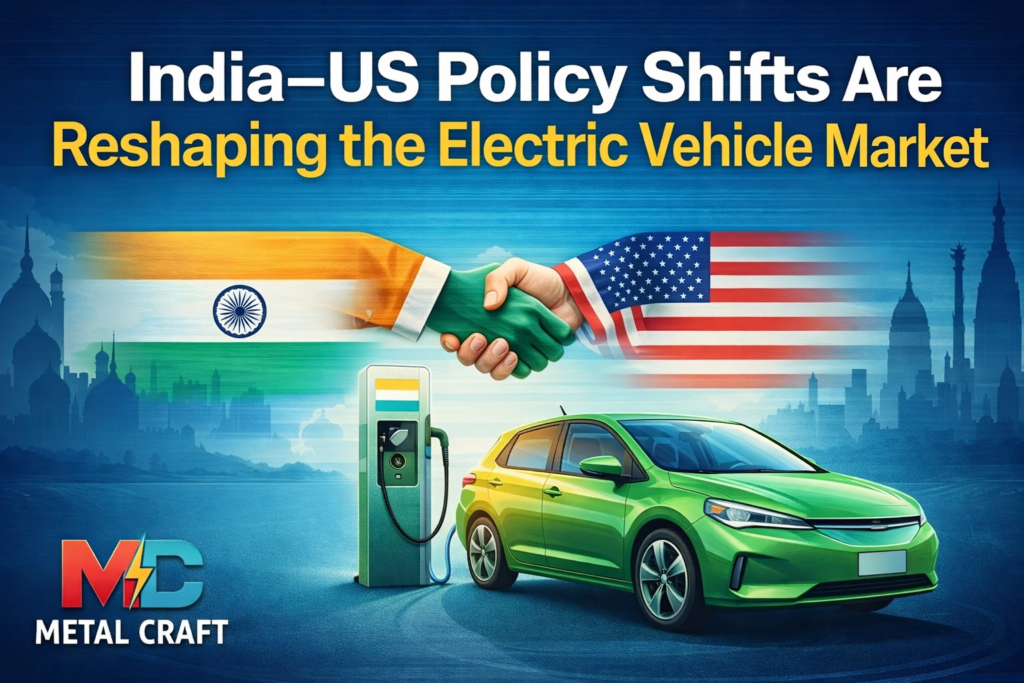
The electric vehicle (EV) market in India is rapidly evolving, driven by supportive policies, global trade developments, and competitive dynamics. In recent years, India has been actively positioning itself as a key destination for EV manufacturing and adoption — not just domestically, but also on the global stage. The ongoing policy discussions between India and the United States, combined with India’s own electric vehicle strategy, are creating new opportunities and challenges for the industry.
New EV Policies to Attract Global Manufacturers Electric Vehicle
India’s government has introduced a focused EV policy aimed at attracting global electric vehicle manufacturers to invest in the country. One of the central components of this is the Scheme to Promote Manufacturing of Electric Passenger Cars in India (SPMEPCI). Under this initiative, companies that commit significant investment — typically a minimum of ₹4,150 crore — in local manufacturing can benefit from significantly lower import duties on electric cars (from about 70% down to just 15%) for a limited number of imports annually.
The policy also requires a phased increase in domestic value addition (DVA) — 25% within three years and 50% within five years — to support local supply chains. These incentives aim to encourage global players to set up manufacturing facilities in India, creating jobs and boosting the local EV ecosystem.
India–US Trade Discussions and EV Market Impacts
Trade talks between India and the United States have become a significant backdrop for EV policy discussions. While the specifics of any trade agreement are still evolving, these discussions are expected to have implications for tariffs and market access. Reducing barriers on imports of EV components or vehicles, in return for investments, could make the Indian market more attractive to U.S. EV makers.
However, not all global players have reacted the same way to India’s incentives. For instance, Tesla has shown interest in the Indian market but has so far focused on sales rather than committing to local manufacturing, despite the reduced import duty scheme being in place.
Boosting Domestic Manufacturing and Local Supply Chains
However, not all global players have reacted the same way to India’s incentives. For instance, Tesla hIndia’s EV policies are not just about attracting foreign companies — they also aim to strengthen domestic manufacturing. The removal of import duties on EV battery components and critical parts was announced to protect local manufacturers from the impact of potential U.S. tariffs and to encourage expansion of the domestic supply chain.
as shown interest in the Indian market but has so far focused on sales rather than committing to local manufacturing, despite the reduced import duty scheme being in place.
This strategic shift signals that India is preparing its industrial ecosystem to be competitive globally, reducing dependence on imports and improving export potential.
Challenges and Competition
While policy incentives provide a strong draw, challenges remain. Some automakers and industry groups have called for clearer guidelines, especially around tariff reductions and implementation timelines. Talks of modifying incentives based on a future India–US trade agreement show how global negotiation outcomes could shape these policies further.
There is also competition from established local EV leaders like Tata Motors and Mahindra & Mahindra, which have built strong domestic manufacturing bases. These firms will continue to drive innovation and production even as global players consider entering or expanding their presence.
Looking Ahead: Opportunities for Growth
India’s EV market is expected to grow substantially in the coming years, bolstered by ambitious goals for electrification, supportive government policies, and increasing consumer acceptance. As India and the U.S. work toward broader trade cooperation, reduced tariffs and clearer investment pathways could further accelerate EV adoption and manufacturing. With the right policy mix and continued focus on infrastructure, India is well on its way to becoming a major EV hub in Asia and the world.